I Hated Teaching Time in Spanish. So We Made Tarde.

Published onSep 20, 2025 • • ViewMusic Videoblog posts
I used to absolutely hate teaching time in my Spanish classes. I had no idea how to make it interesting.
I’d put students into groups and hand out those little cardstock clocks. I’d call out times. They’d move the hands. Then I’d realize some kids didn’t know what “quarter past” or “quarter to” meant, so we’d detour into that.
Then I’d realize half the kids didn’t know what the big hand and little hand meant, so we’d detour again.

Eventually, a student, drool hanging from their mouth, would ask, “Why is time?”
I’d shake off the fog and look around. Two weeks had passed. The cardstock clocks had all been eaten. The board was covered in ancient Babylonian mathematics explaining why there are 60 minutes in an hour. And all of us, including me, had completely forgotten how to tell time in Spanish.
But all those detours overlooked the elephant in the room.
I mean, isn't that the problem with so many everyday questions we teach in beginning Spanish?
In the real world, the answers can matter enormously. But in a classroom exercise, there are no stakes. The question is lifeless. The answer is lifeless. Eventually, the Spanish feels lifeless too.
But what if knowing the exact time actually mattered? What if being off by fifteen minutes was evidence that something was seriously wrong?
That’s what we built Tarde around.
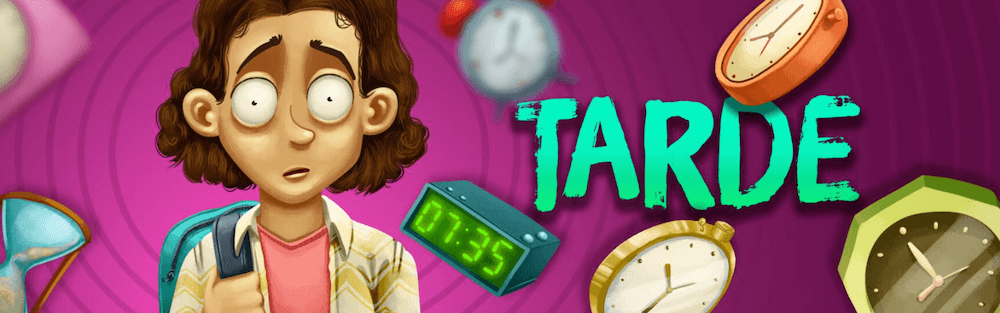
What if the clock stopped making sense?
Tarde is a Señor Wooly Spanish music video about Santiago, a rule-following student who prides himself on being prepared and on time. It’s probably the closest we’ve ever come to making our own Spanish-language episode of The Twilight Zone.
But one day, the clocks stop agreeing with him. He thinks he’s early. His teacher says he’s late. And every time he checks, the discrepancy gets worse.

The language is inside the problem
Tarde is designed to teach telling time in Spanish through the conflict of the story. Telling time isn’t a vocabulary topic that gets stapled onto the story afterward. It’s part of the conflict.
Santiago needs to understand tarde, temprano, a tiempo, and en punto. He needs to ask ¿Qué hora es? and ¿Cuántos minutos faltan?
Even forms of llegar keep appearing naturally: llegué, llegaste, llegó.
None of that language is there because we started with a list of things students ought to learn.
It’s there because Santiago has a problem. And if students want to understand his problem, they need the language.
Story first
This is a pretty good example of what I mean when I say that Wooly is built around stories rather than vocabulary lists.
We didn’t start Tarde by asking, “How can we make a video that teaches telling time?”
We started with Santiago. He’s organized. He’s prepared. He likes having everything under control.
So what happens if we take away the one thing he depends on most?
That’s the kind of relationship between story and language that we’re always looking for at Wooly. Students aren’t learning the Spanish so they can finish an exercise. They need the Spanish because the characters need it.
If you want to read more about that philosophy, I wrote a whole article about why we teach Spanish through stories instead of vocabulary lists.
A full week with Tarde
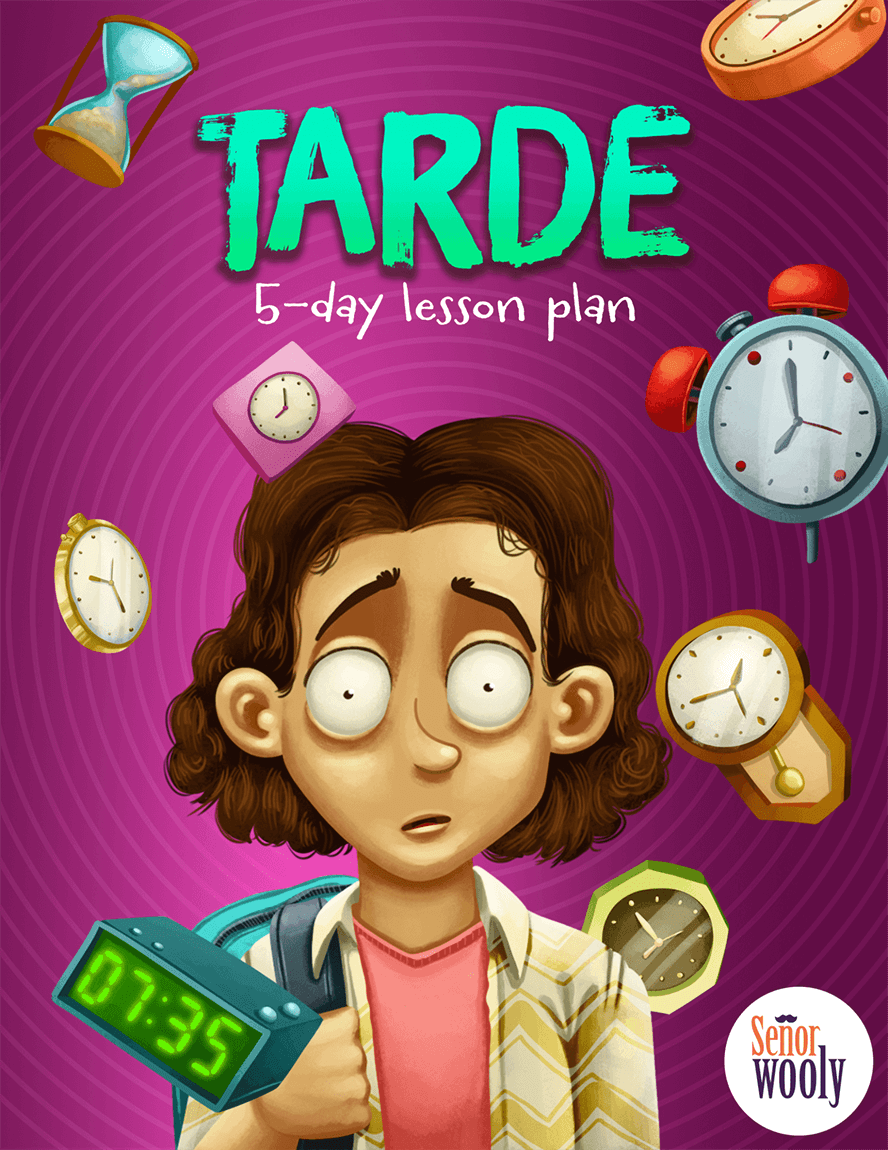
Tarde includes a complete 5-day Spanish lesson plan for teaching time, punctuality, arriving late, arriving early, and being on time.
The plan gives students multiple opportunities to work with the language through comprehension, discussion, interpretation, and classroom interaction.
So if you need to teach telling time, you can now do it through a strange little nightmare in which a student slowly discovers that the clocks around him can no longer be trusted.
Which, at least for me, beats the cardstock clocks.
Already have Wooly?
Log in and go straight to Tarde in the story catalog.
New to Wooly?
See how Señor Wooly uses stories, music, and classroom materials to make Spanish worth paying attention to.


